Standards Review
If you have trouble accessing the files on this page, please contact the Bureau of Standards and Instructional Support at 850-245-0423.
Science Standards Review Public Comment: September – October 2026
Science Standards Listening Tour
The Science Standards Listening Tour will include the following opportunities for public input:
October 27, 2026: Orange County
5:30 – 7:30 p.m. ET, with preregistration starting at 5:00 p.m.
Lake Buena Vista High School
11305 Daryl Carter Parkway
Orlando, FL 32836
October 5, 2026: Walton County
5:00 – 7:00 p.m. CT, with preregistration starting at 4:30 p.m.
Walton High School
449 Walton Road
DeFuniak Springs, FL 32433
September 30, 2026: Virtual Option
Join us virtually: Teams Meeting
4:00 – 6:00 p.m. ET
September 29, 2026: Hillsborough County
5:00 – 7:00 p.m. ET, with preregistration starting at 4:30 p.m.
Armwood High School
12000 E. US Highway 92
Seffner, FL 33584
Introduction
The Florida K-12 Benchmarks for Excellent Student Thinking (B.E.S.T.) Standards for Science establish a coherent and vertically aligned learning framework for science education that prepares students to understand the natural world, think critically about scientific ideas, solve problems, evaluate evidence, and apply scientific knowledge in meaningful ways. The standards are designed to support student learning by developing scientifically literate individuals who can investigate phenomena, communicate scientific understanding, make informed decisions based on evidence, and continue learning throughout their lives.
At their core, the purpose of Florida’s K-12 B.E.S.T. Standards for Science is to support student learning. The standards establish clear expectations for what students should know, understand, and be able to do at each grade level while providing educators with a coherent framework for benchmarks-aligned, high-quality instruction. Through this progression, students build scientific knowledge, develop reasoning skills, and learn to apply their understanding to explain phenomena, analyze evidence, and solve problems. Students also develop systems thinking by identifying components, boundaries, interactions, inputs, outputs, and feedback within natural and human-made systems.
Science education in Florida emphasizes both disciplinary knowledge and scientific thinking. Students progressively develop understanding of energy, matter, force and motion; planet Earth and space; and life sciences while engaging in the practices used by scientists and engineers to investigate questions, analyze evidence, construct explanations, develop models, evaluate solutions, and communicate findings. Across all grade levels, students learn that scientific knowledge is built through observation, investigation, reasoning, collaboration, innovation, and continual refinement based on evidence.
To strengthen relevance and engagement, the Florida K-12 B.E.S.T. Standards for Science intentionally incorporate Florida-specific examples, phenomena, organisms, ecosystems, industries, technologies, agricultural systems, and natural resources whenever those contexts support the scientific concepts being taught. Students encounter connections to Florida’s environments, agricultural systems, forests, wetlands, springs, rivers, estuaries, coastal regions, fisheries, space industry, weather patterns, energy resources, and communities throughout their K-12 science experience. These examples are not separate content expectations, but rather meaningful contexts that help students apply scientific knowledge to authentic situations while building understanding of Florida’s environmental, economic, and cultural significance. By embedding Florida-based contexts throughout the standards, students develop deeper connections between scientific concepts and the natural systems, resources, and industries that shape their state.
Foreword
K-12 TABLES: Mathematics Skills, Modeling Skills, Laboratory Practices, and a Timeline (PDF)
Refer to this document simultaneously during your review of the standards and benchmarks for each of the grade bands.
Proposed Drafts B.E.S.T. K-12 Science Standards
These documents are provided for review purposes only and do not represent final or approved versions. Formatting and content may be revised before final publication.
Benchmarks for Excellent Student Thinking (B.E.S.T.) Standards for Kindergarten – Grade 12
Kindergarten – Grade 5 B.E.S.T. Standards and Benchmarks for Science (6 FORMS)
There are 6 FORMS to review for the B.E.S.T. Standards for Science for K-5.
- Begin your review with the Scientific Thinking and Reasoning Standards (STARS) first. The STARS will be included in all K-12 Science courses.
- Access the tables and refer to them during the standards review. The review of the tables and standards will be done simultaneously.
- The tables will be referred to in Parts 1-4 of the Standards Review for each grade band.
- There will be 4 parts of the K-5 Science Standards and Benchmarks.
- Part 1 is in the discipline of Energy, Matter, and Force and Motion
- Part 2 is in the discipline of Planet Earth and Space
- Parts 3 and 4 are in the discipline of Life.
- NOTE: You will be given an opportunity at the end of Part 4 to review additional grade bands.
BEGIN YOUR REVIEW HERE:
K-12 STARS: Scientific Thinking and Reasoning Standards
K-12 Scientific Thinking and Reasoning Standards (STARS)
K-5 Part 1: Energy, Matter, and Force and Motion Standards and Benchmarks
K-5 PART 1: Energy, Matter, and Force and Motion Standards and Benchmarks
- The Science of Energy
- The Science of Matter
- The Science of Force and Motion
K-5 Part 2: Planet Earth and Space Standards and Benchmarks
K-5 PART 2: Planet Earth and Space Standards and Benchmarks
- The Science of Planet Earth
- The Science of Space
K-5 Part 3: Life Standards and Benchmarks (part 1 of 2)
K-5 PART 3: Life Standards and Benchmarks (part 1 of 2)
K-5 Part 4: Life Standards and Benchmarks (part 2 of 2)
K-5 PART 4: Life Standards and Benchmarks (part 2 of 2)
- The Science of Human Body
- The Science of Nutrition
- The Science of Fungi
- The Science of Microorganisms
K-12 TABLES: Mathematics Skills, Modeling Skills, Laboratory Practices, and a Timeline
K-12 TABLES: Mathematics Skills, Modeling Skills, Laboratory Practices, and a Timeline
Grade 6–8 B.E.S.T. Standards and Benchmarks for Science (6 FORMS)
There are 6 FORMS to review for the B.E.S.T. Standards for Science for 6-8.
- Begin your review with the Scientific Thinking and Reasoning Standards (STARS) first. The STARS will be included in all K-12 Science courses.
- Access the tables and refer to them during the standards review. The review of the tables and standards will be done simultaneously.
- The tables will be referred to in Parts 1-4 of the Standards Review for each grade band.
- There will be 4 parts of the 6-8 Science Standards and Benchmarks.
- Part 1 is in the discipline of Energy, Matter, and Force and Motion
- Part 2 is in the discipline of Planet Earth and Space
- Parts 3 and 4 are in the discipline of Life.
- NOTE: You will be given an opportunity at the end of Part 4 to review additional grade bands.
BEGIN YOUR REVIEW HERE:
K-12 STARS: Scientific Thinking and Reasoning Standards
K-12 Scientific Thinking and Reasoning Standards (STARS)
6-8 PART 1: Energy, Matter, and Force and Motion Standards and Benchmarks
- The Science of Energy
- The Science of Matter
- The Science of Force and Motion
6-8 PART 2: Planet Earth and Space Standards and Benchmarks
- The Science of Planet Earth
- The Science of Space
6-8 PART 3: Life Standards and Benchmarks (part 1 of 2)
- The Science of Life
- The Science of Cell Biology
- The Science of Plants
- The Science of Animals
6-8 PART 4: Life Standards and Benchmarks (part 2 of 2)
- The Science of Human Body
- The Science of Nutrition
- The Science of Fungi
- The Science of Microorganisms
- Applying the Science of Life
K-12 TABLES: Mathematics Skills, Modeling Skills, Laboratory Practices, and a Timeline
Grade 9–12 B.E.S.T. Standards and Benchmarks for Science (18 FORMS)
There are 18 FORMS to review for the B.E.S.T. Standards for Science for 9-12.
- Begin your review with the Scientific Thinking and Reasoning Standards (STARS) first. The STARS will be included in all K-12 Science courses.
- Access the tables and refer to them during the standards review. The review of the tables and standards will be done simultaneously.
- The tables will be referred to in Parts 1-16 of the Standards Review for each grade band.
- There will be 16 parts of the 9-12 Science Standards and Benchmarks.
- Parts 1-3 are in the discipline of Energy, Matter, and Force and Motion
- Parts 4-5 are in the discipline of Planet Earth and Space
- Parts 6-16 are in the discipline of Life.
- NOTE: You will be given an opportunity at the end of Part 16 to review additional grade bands.
BEGIN YOUR REVIEW HERE:
K-12 STARS: Scientific Thinking and Reasoning Standards
K-12 Scientific Thinking and Reasoning Standards (STARS)
9-12 Parts 1-3: Energy, Matter, and Force and Motion Standards and Benchmarks:
9-12 PART 1: Energy, Matter, and Force and Motion Standards and Benchmarks
- The Science of Energy
- The Science of Energy in Earth Systems
- The Science of Energy in Space Systems
9-12 PART 2: Energy, Matter, and Force and Motion Standards and Benchmarks
- The Science of Energy in Living Systems
- The Science of Matter
9-12 PART 3: Energy, Matter, and Force and Motion Standards and Benchmarks
- The Science of Force and Motion
9-12 Parts 4-5: Planet Earth and Space Standards and Benchmarks:
9-12 PART 4: Planet Earth and Space Standards and Benchmarks
- The Science of Planet Earth
9-12 PART 5: Planet Earth and Space Standards and Benchmarks
- The Science of Space
9-12 Parts 6-16: Planet Earth and Space Standards and Benchmarks:
9-12 PART 6: Life Standards and Benchmarks, The Science of Life
9-12 PART 7: Life Standards and Benchmarks, The Science of Cell Biology
9-12 PART 8: Life Standards and Benchmarks, The Science of Plants (part 1 of 2)
9-12 PART 9: Life Standards and Benchmarks, The Science of Plants (part 2 of 2)
9-12 PART 10: Life Standards and Benchmarks, The Science of Animals (part 1 of 3)
9-12 PART 11: Life Standards and Benchmarks, The Science of Animals (part 2 of 3)
9-12 PART 12: Life Standards and Benchmarks, The Science of Animals (part 3 of 3)
9-12 PART 13: Life Standards and Benchmarks, The Science of Human Body and the Science of Nutrition
9-12 PART 14: Life Standards and Benchmarks, The Science of Fungi
9-12 PART 15: Life Standards and Benchmarks, The Science of Microorganisms
9-12 PART 16: Life Standards and Benchmarks, Applying the Science of Life
K-12 TABLES: Mathematics Skills, Modeling Skills, Laboratory Practices, and a Timeline
K-12 TABLES: Mathematics Skills, Modeling Skills, Laboratory Practices, and a Timeline
Standards Under Review – Fall 2026
Standards Under Review – Spring 2023
- Draft Financial Literacy Strand 9-12 (Social Studies Standards) (PDF)
- Provide specific feedback through April 13 at https://survey.alchemer.com/s3/7264902/Alchemer-Support
- Draft Social Media and Screen Time Benchmarks K-12 (Health Education Standards) (PDF)
- Provide specific feedback through April 13 at https://survey.alchemer.com/s3/7299035/Florida-Department-of-Education-Social-Media-Internet-Safety-Standards
- Draft Social Studies Access Points – Alternate Academic Achievement Standards K-12 (PDF)
A public workshop will be held Friday, April 7, at 1:00 pm Eastern. Details available at https://web02.fldoe.org/rules/Default. Comments can also be submitted on that webpage.
Standards Under Review – Spring 2021
Memo to School Districts May 28, 2021 (PDF)
Memo to School Districts March 26, 2021 (PDF)
2021 Standards Listening Tour
Listening Tour Presentation (PDF)
Tuesday, June 1 – Miami-Dade County
Thursday, June 3 – Osceola County
Wednesday, June 9 – Baker County
Rule Development Workshop on June 2, 2021, at 11:30 am EDT
- Workshop Presentation (PDF)
Rule Development Workshop on April 9, 2021, at 11:00 am EDT
- Workshop Presentation (PDF)
- Workshop Comments (PDF)
Proposed Standards for July 2021 State Board of Education Meeting
- Proposed Social Studies Standards (includes revised Civics and Government and new Holocaust Education) (PDF)
- Proposed Health Education Standards (includes new Character Education and new Substance Use and Abuse) (PDF)
- Proposed Access Points – Alternate Academic Achievement Standards for Student with the Most Significant Cognitive Disabilities
- Proposed English Language Arts Standards Revisions (PDF)
- Note: These revisions are minor or technical and will not affect implementation.
English Language Arts & Mathematics Standards Review
- Recommendations for Achieving The Benchmarks for Excellent Student Thinking (B.E.S.T.) Standards in Florida (PDF)
- Quick Facts (PDF)
- B.E.S.T. Standards in English Language Arts (PDF)
- B.E.S.T. Standards in Mathematics (PDF)
- Adoption and Implementation Memo to School Districts – February 13, 2020 (PDF)
- Presentation to State Board of Education – February 12, 2020 (PDF)
For more information about professional development for ELA, please visit the Just Read Florida! website.
For more information about professional development for mathematics, please visit the Bureau of Standards and Instructional Support mathematics website.
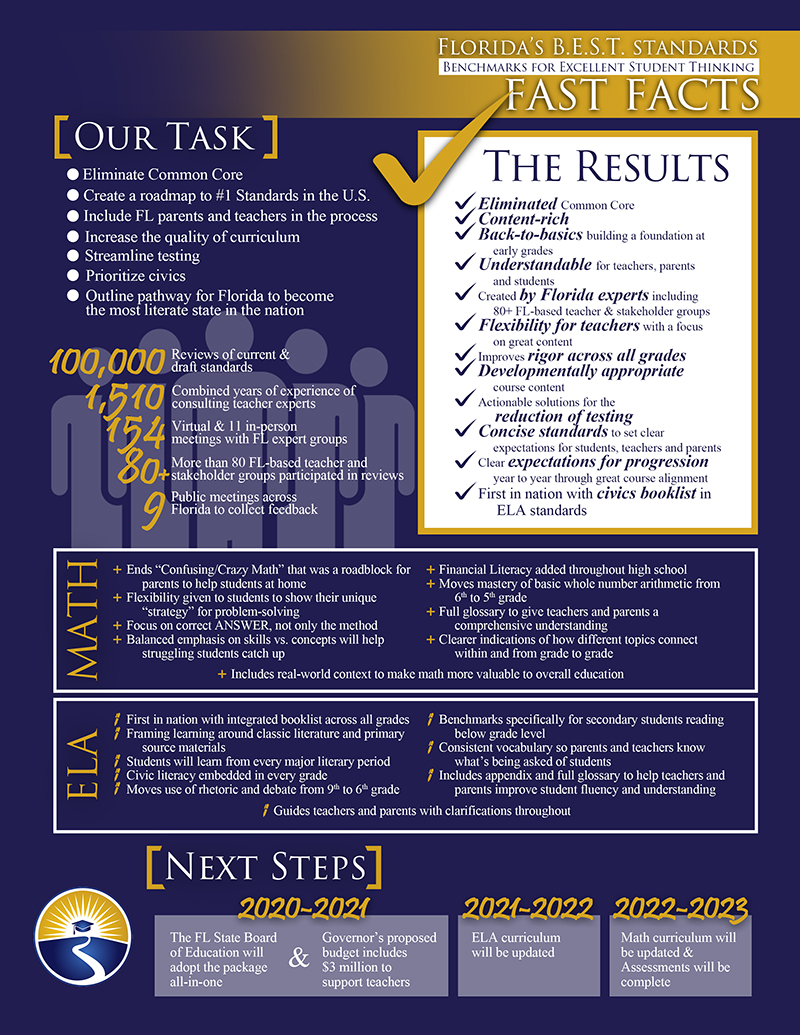
On January 31, 2019, Governor Ron DeSantis issued Executive Order 19-32, outlining a path for Florida to improve its education system by eliminating Common Core and paving the way for Florida students to receive a world-class education to prepare them for jobs of the future.
Executive Order 19-32 directs Florida Department of Education Commissioner Richard Corcoran to comprehensively review the academic standards for Florida’s Kindergarten through grade twelve students and provide recommended revisions to Governor DeSantis. The recommendations shall:
- Articulate how Florida will eliminate Common Core (Florida Standards) and ensure we return to the basics of reading, writing and arithmetic;
- Provide a roadmap to make Florida’s standards number one in the nation;
- Reflect Florida Department of Education Commissioner Richard Corcoran’s consultation with relevant stakeholders to include parents and teachers;
- Deem how to increase the quality of instructional curriculum;
- Suggest innovative ways to streamline testing;
- Identify opportunities to equip high school graduates with sufficient knowledge of America’s civics, particularly the principles reflected in the United States Constitution, so as to be capable of discharging the responsibilities associated with American citizenship; and
- Outline a pathway for Florida to be the most literate state in the nation.
Standards Review Timeline Through April 2020 (PDF)
Presentations & Communications
- Chancellor Jacob Oliva Presentation to School Districts - February 13, 2019 (PDF)
- Presentations also made to:
- Florida Standards Academy - February 20, 2019
- Secondary CTE Directors State Meeting - February 20, 2019
- Florida Philanthropic Network - February 26, 2019
- Panhandle Area Education Consortium - February 26, 2019
- Impact Florida - February 28, 2019
- ESOL, Title III, and World Languages district staff - February 28, 2019
- Assessment Content Advisory Committee – February 28, 2019
- Florida Association of Colleges of Teacher Education – March 1, 2019
- East Coast Technical Assistance Center – March 1, 2019
- STEMposium content developers – March 4, 2019
- Consortium of Florida Education Foundations - March 6, 2019
- Florida Association of District School Superintendents - March 15, 2019
- Florida PTA - March 25, 2019
- Real Talk Coalition - March 25, 2019
- Florida Children and Youth Cabinet - March 25, 2019
- Hamilton County School Board - March 26, 2019
- University of Central Florida College of Education Doctoral Students - March 27, 2019
- Leadership Bay - March 27, 2019
- Leadership Florida Education Class IV - March 28, 2019
- JaxUSA Regional Partner Forum - April 5, 2019
- Florida Philanthropic Network - April 16, 2019
- High Impact Teacher Corps Graduation - May 9, 2019
- FASFEPA - May 15, 2019
- FOIL - May 15, 2019
- STEMposium facilitators - May 24, 2019
- Consortium of Florida Education Foundation - June 12, 2019
- FSBA/FADSS Joint Conference - June 13, 2019
- FSU Learning Systems Institute Access and Equity Conference - June 14, 2019
- NEFEC Summer Leadership Conference - July 9, 2019
- PAEC Leadership Conference - July 23, 2019
- School Improvement Summer Academy - July 24, 2019
- School Improvement North Area Academy - July 31, 2019
- Annual Assessment and Accountability Meeting - August 28, 2019
- Presentations also made to:
- Memo to School Districts February 15, 2019 (PDF)
- Memo to School Districts April 5, 2019 (PDF)
- Press Release April 8, 2019
- Stakeholder Email May 31, 2019 (Word)
- Stakeholder Email August 12, 2019 (Word)
- Stakeholder Email September 20, 2019 (Word)
- Florida Standards Listening Tour (PDF)
- October 7, 2019, Sebring Middle School
- October 8, 2019, Winter Springs High School
- October 10, 2019, Alachua County School District Office
- October 14, 2019, John I. Leonard High School
- October 16, 2019, Collier County School District Office
- October 17, 2019, Jefferson High School
- October 21, 2019, Liberty Pines Academy
- October 22, 2019, Hamilton County High School
- October 23, 2019, Walton High School
- Press Release/Stakeholder Email January 24, 2020
- Memo to School Districts and Stakeholders January 31, 2020
- Press Release February 7